
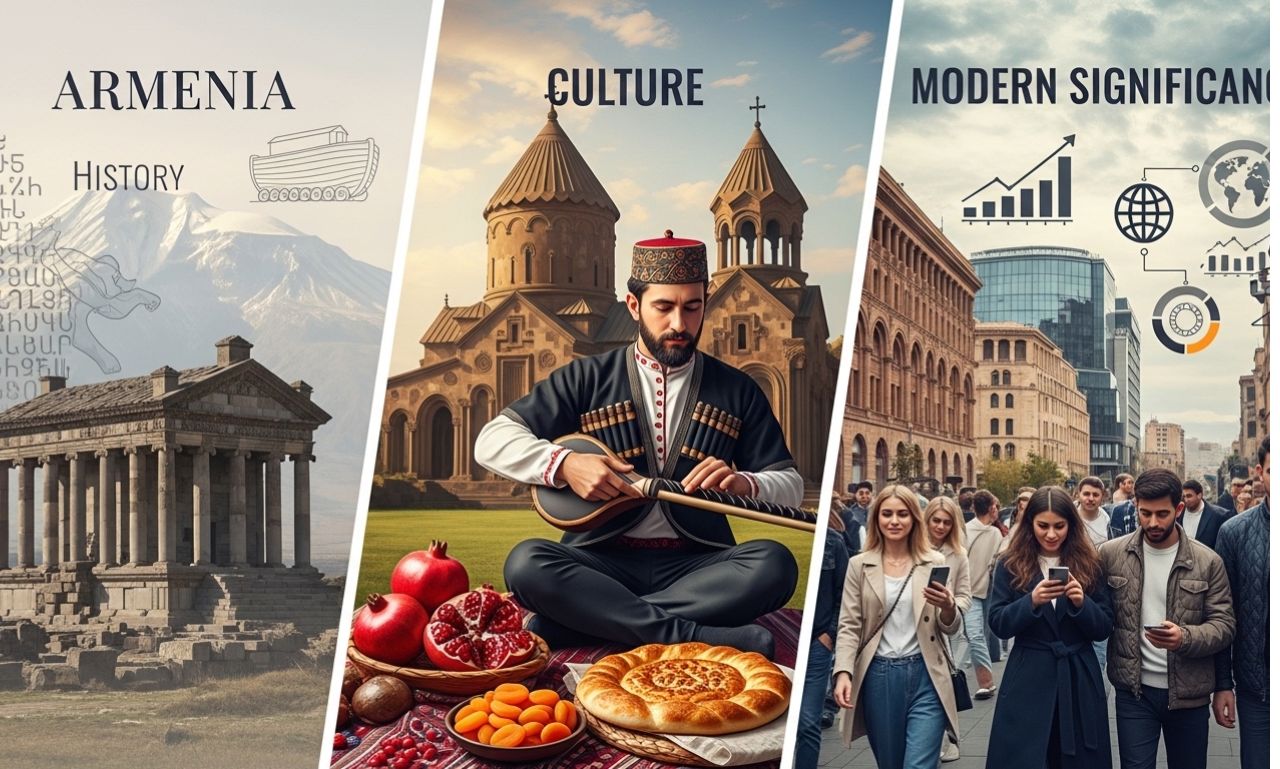
Armenia is a landlocked country located in the South Caucasus region of Eurasia, bordered by Turkey, Georgia, Azerbaijan, and Iran. Known as one of the world’s oldest civilizations, Armenia has a rich history, vibrant culture, and unique language and alphabet.
With a population of around 3 million people, Armenia has maintained its identity despite centuries of foreign invasions, occupations, and political challenges. This article explores Armenia’s history, culture, geography, economy, and modern relevance.
Geography and Natural Features
Location and Landscape
Armenia is situated in the mountainous region of the South Caucasus. Its terrain is largely rugged, with numerous mountains, rivers, and lakes. Notable features include:
-
Mount Ararat: A national symbol, though it lies in present-day Turkey.
-
Lake Sevan: One of the largest freshwater high-altitude lakes in the world.
-
Tavush and Lori regions: Known for forests, valleys, and scenic beauty.
Climate
Armenia has a continental climate, with hot summers and cold, snowy winters. The high elevation in many regions influences temperature variations and agricultural practices.
History of Armenia
Ancient Armenia
Armenia has a history dating back thousands of years. It was home to early civilizations such as the Urartu Kingdom (9th–6th century BCE). Armenia became notable for its early adoption of Christianity, with Armenia officially becoming the first Christian nation in 301 AD under King Tiridates III.
Medieval Period
During the medieval period, Armenia was often caught between empires, including the Byzantine, Persian, and Ottoman empires. Despite this, Armenians maintained their language, religion, and cultural traditions.
Modern History
In the 20th century, Armenia experienced dramatic changes:
-
Armenian Genocide (1915): Millions of Armenians were killed or displaced during the Ottoman Empire’s mass exterminations.
-
Soviet Era: Armenia became part of the Soviet Union from 1922 until 1991.
-
Independence: Armenia declared independence from the USSR on September 21, 1991, establishing the Republic of Armenia.
Culture and Society
Language and Alphabet
Armenians speak Armenian, a distinct Indo-European language with its own alphabet, created by Mesrop Mashtots in 405 AD. The alphabet is a source of pride and cultural identity for Armenians.
Religion
Armenia is predominantly Christian, following the Armenian Apostolic Church, one of the oldest Christian denominations in the world. Churches and monasteries are central to Armenian culture, history, and architecture.
Traditions and Festivals
Armenia has rich traditions, including music, dance, and cuisine. Notable cultural practices include:
-
Vardavar: A water festival celebrated with family and community participation.
-
Armenian cuisine: Includes dishes like khorovats (barbecue), dolma, and lavash (traditional bread).
Economy and Development
Key Sectors
Armenia’s economy relies on:
-
Agriculture: Fruits, vegetables, and wine production.
-
Mining: Copper, molybdenum, and gold.
-
Technology and IT: Growing software and tech industry hubs.
-
Tourism: Attractions include ancient monasteries, Mount Ararat, and cultural festivals.
Challenges and Opportunities
Armenia faces challenges such as limited natural resources, geopolitical tensions, and a landlocked geography affecting trade. However, technology and tourism offer opportunities for economic growth and international engagement.
Political Structure
Armenia is a unitary parliamentary republic. The government consists of a president, prime minister, and National Assembly, with elections held regularly to ensure democratic representation.
Foreign Relations
Armenia maintains close relations with Russia, is a member of the Eurasian Economic Union (EAEU), and engages in diplomatic efforts in the South Caucasus. Conflicts, particularly over Nagorno-Karabakh, have influenced foreign policy and security priorities.
Tourism and Landmarks
Arm enia is home to numerous historical and natural landmarks, making it a growing destination for travelers:
-
Geghard Monastery: A UNESCO World Heritage site carved into rock cliffs.
-
Khor Virap Monastery: Offers stunning views of Mount Ararat.
-
Lake Sevan: Popular for recreation and cultural significance.
-
Yerevan: The capital city, known for its architecture, museums, and vibrant nightlife.
Armenia in the Modern Era
Today, Armenia balances tradition and modernization. Its people maintain strong cultural identity while embracing technology, global trade, and education. Ar menia also actively participates in international organizations and peace-building efforts in the region.
Conclusion
Ar menia is a country of ancient heritage, resilience, and cultural richness. Its history, from the earliest civilizations to modern independence, demonstrates a unique ability to preserve identity amid challenges. Ar menia’s mountains, traditions, churches, and festivals continue to define its character and attract global attention.
Understanding Ar menia’s geography, culture, economy, and history provides insight into a nation that, despite being small in size, has had a significant impact on world history and culture.